
Dies ist eine alte Version des Dokuments!
Aerosole als als Faktoren im globalen Klima
Mira Pöhlker
Kernanliegen
- Welche Rolle spielen Aerosole im Klimasystem?
- Wie beeinflusst menschliches Handeln ihre Eigenschaften?
Zusammenfassung
In addition to long-lived climate drivers such as CO2, aerosol particles represent a significant short-lived climate driver that can affect the Earth's radiative budget (Figure 1). Aerosols can either directly scatter or absorb sunlight, or act as cloud nuclei, thereby influencing the Earth's radiative balance. They can arise from spray, technical, and biological sources (Figure 2), and also volcanic eruptions (Figure 3). To gain a deeper understanding of how human activities have influenced the Earth's climate and how future climate change may unfold in the context of reduced human emissions, it is essential to have a basic grasp of the aerosol climate effect. However, this understanding is complex. Aerosols can both warm and cool the Earth's climate due to they impact on the shortwave and longwave radiation budget (cf. Figure 1).
This presentation will provide a fundamental understanding of the effect of aerosols on the Earth's climate and present the latest results obtained using a wide range of methods employed in aerosol and climate research.
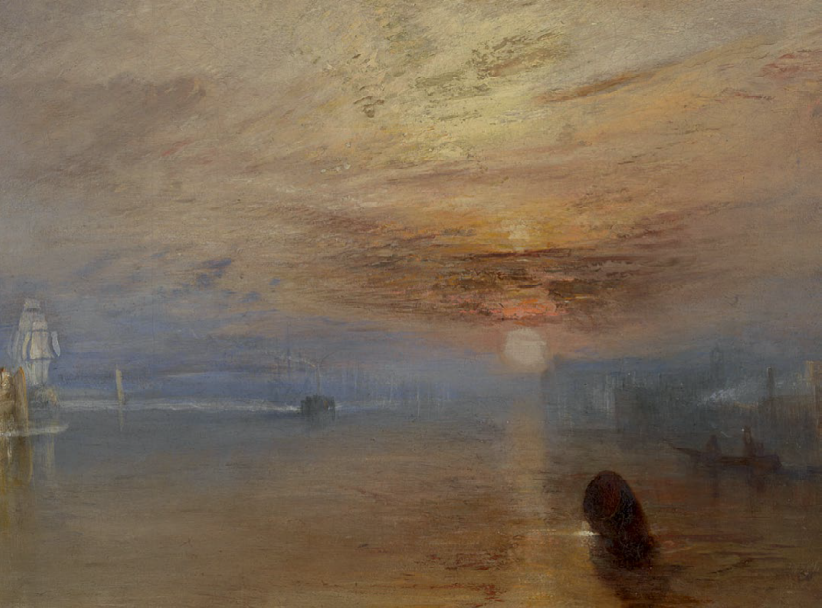 Abbildung 3. William Turners Gemälde “Fighting Temeraire” aus dem Jahr 1838, kurz nach der Eruption des Tambora 1815.
Quelle: siehe Seite 10 in [3].
Abbildung 3. William Turners Gemälde “Fighting Temeraire” aus dem Jahr 1838, kurz nach der Eruption des Tambora 1815.
Quelle: siehe Seite 10 in [3].
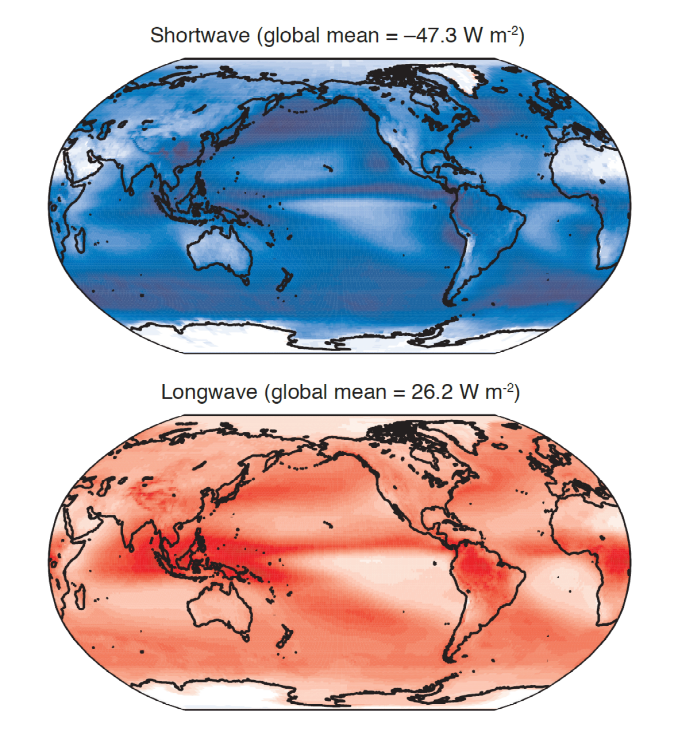 Abbildung 1. Beitrag von kurzwelliger (oben) und langwelliger (unten) Strahlung zur Wärmebilanz der Erde.
Quellen: Tafeln (a) und (b) von Abb 7.7 aus
Abbildung 1. Beitrag von kurzwelliger (oben) und langwelliger (unten) Strahlung zur Wärmebilanz der Erde.
Quellen: Tafeln (a) und (b) von Abb 7.7 aus  Abbildung 2. Beispiele von atmosphärischen Teilchen und Bio-Aerosolen. Quelle: Abb. 1 aus
 Literature
- O. Boucher, D. Randall, P. Artaxo, C. Bretherton, G. Feingold, P. Forster, V.-M. Kerminen, Y. Kondo, H. Liao, U. Lohmann, P. Rasch, S.K. Satheesh, S. Sherwood, B. Stevens and X.Y. Zhang: Clouds and Aerosols. In: Climate Change 2013: The Physical Science Basis. Contribution of Working Group I to the Fifth Assessment Report of the Intergovernmental Panel on Climate Change [Stocker, T.F., D. Qin, G.-K. Plattner, M. Tignor, S.K. Allen, J. Boschung, A. Nauels, Y. Xia, V. Bex and P.M. Midgley (eds.)]. Cambridge University Press 2013, Cambridge, United Kingdom and New York, NY, USA.
- Janine Fröhlich-Nowoisky, Christopher J. Kampf, Bettina Weber, J. Alex Huffman, Christopher Pöhlker, Meinrat O. Andreae, Naama Lang-Yona, Susannah M. Burrows, Sachin S. Gunthe, Wolfgang Elbert, Hang Su, Peter Hoor, Eckhard Thines, Thorsten Hoffmann, Viviane R. Després, Ulrich Pöschl: Bioaerosols in the Earth system: Climate, health, and ecosystem interactions. Atmospheric Research 182 (2016) 346-376.
- S. Brönnimann, D. Krämer: Tambora and the “Year Without a Summer” of 1816. A Perspective on Earth and Human Systems Science. Geographica Bernensia G90 (2016).
Vortrag am 13. November 2025 — Ringvorlesung in Winter Term 2025/26