book:chap1:1.3_order-of-magnitude_guesses
Differences
This shows you the differences between two versions of the page.
| Both sides previous revisionPrevious revisionNext revision | Previous revision | ||
| book:chap1:1.3_order-of-magnitude_guesses [2021/10/07 06:14] – jv | book:chap1:1.3_order-of-magnitude_guesses [2022/04/01 19:28] (current) – jv | ||
|---|---|---|---|
| Line 1: | Line 1: | ||
| + | [[basics| 1. Basic Principles]] | ||
| + | * [[ 1.1 Basic notions of mechanics ]] | ||
| + | * [[ 1.2 Dimensional analysis ]] | ||
| + | * ** 1.3 Order-of-magnitude guesses ** | ||
| + | * [[ 1.4 Problems ]] | ||
| + | * [[ 1.5 Further reading ]] | ||
| + | |||
| + | ---- | ||
| + | |||
| ===== 1.3 Order-of-magnitude guesses ===== | ===== 1.3 Order-of-magnitude guesses ===== | ||
| Many physical quantities take a value close to one | Many physical quantities take a value close to one | ||
| - | when they are expressed in their ``natural'' | + | when they are expressed in their “natural” dimensionless units. |
| When the choice is unique, then clearly it is also natural. | When the choice is unique, then clearly it is also natural. | ||
| Otherwise, the appropriate choice is a matter of experience. | Otherwise, the appropriate choice is a matter of experience. | ||
| Line 8: | Line 17: | ||
| We demonstrate this based on a discussion of | We demonstrate this based on a discussion of | ||
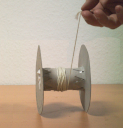
| + | <WRAP right 150px # | ||
| {{ book: | {{ book: | ||
| - | <wrap hide> | + | Figure 1.3: Pendulum discussed in [[# |
| - | \label{figure: | + | </WRAP> |
| - | <WRAP box round> | + | <WRAP box round # |
| We consider a pendulum of mass $M$ attached at a stiff bar of negligible mass. | We consider a pendulum of mass $M$ attached at a stiff bar of negligible mass. | ||
| With this bar it is fixed to a pivot at a distance $L$ from the mass | With this bar it is fixed to a pivot at a distance $L$ from the mass | ||
| Line 17: | Line 27: | ||
| In this example we make use of the fact that the bar has fixed length $L$, | In this example we make use of the fact that the bar has fixed length $L$, | ||
| and describe the position of the mass by the angle $\theta(t)$ | and describe the position of the mass by the angle $\theta(t)$ | ||
| - | (see figure right). | + | (see [[# |
| \\ | \\ | ||
| - | As discussed in \Example{pendulum-nodim} the dimensionless | + | As discussed in [[book: |
| - | Hence we estimate that the period $T$ of the pendulum is of the order of | + | Hence, we estimate that the period $T$ of the pendulum is of the order of |
| $ | $ | ||
| T \simeq \sqrt{L/ | T \simeq \sqrt{L/ | ||
| Line 37: | Line 47: | ||
| </ | </ | ||
| - | <WRAP box round> | + | <WRAP box round # |
| A Tsunami wave is a water wave that is generated by an earth quake or an underwater land slide. | A Tsunami wave is a water wave that is generated by an earth quake or an underwater land slide. | ||
| Typical wave lengths are of an order of magnitude $\lambda = 100\, | Typical wave lengths are of an order of magnitude $\lambda = 100\, | ||
| Line 53: | Line 63: | ||
| \frac{L}{ v_{\text{Tsunami}} } | \frac{L}{ v_{\text{Tsunami}} } | ||
| \approx \frac{ 1 \times 10^{4}\, | \approx \frac{ 1 \times 10^{4}\, | ||
| - | = \frac{100}{7} \text{h} | + | = \frac{100}{7}\,\text{h} |
| \approx 15\, | \approx 15\, | ||
| \] | \] | ||
| Line 67: | Line 77: | ||
| T \approx \frac{\lambda}{ v_{\text{Tsunami}} } | T \approx \frac{\lambda}{ v_{\text{Tsunami}} } | ||
| = \frac{ \lambda }{ \sqrt{ g D } } | = \frac{ \lambda }{ \sqrt{ g D } } | ||
| - | = \frac{ 100\text{km} }{ 700\text{km/ | + | = \frac{ 100\,\text{km} }{ 700\,\text{km/h} } |
| = \frac{1}{ 7\,\text{h} } | = \frac{1}{ 7\,\text{h} } | ||
| \approx 10\, | \approx 10\, | ||
| Line 77: | Line 87: | ||
| ==== Self Test ==== | ==== Self Test ==== | ||
| - | + | <WRAP # | |
| - | Problem 1.5: <wrap hide> | + | Problem 1.5: |
| ** Printing the output of Phantom cameras ** | ** Printing the output of Phantom cameras ** | ||
| \\ | \\ | ||
| - | With a set of three phantom cameras one can simultaneously follow the motion of 100 particles | + | With a set of three phantom cameras one can simultaneously follow the motion of $100$ particles |
| in a violent 3d turbulent flow. | in a violent 3d turbulent flow. | ||
| - | Data analysis of the images provides particle positions with a resolution of 25,000 frames per second. | + | Data analysis of the images provides particle positions with a resolution of $25\,000$ frames per second. |
| - | You follow the evolution for 20\text{minute}, | + | You follow the evolution for $20\,\text{minute}$, |
| - | print it double paged with 8 coordinates per line and 70 lines per page. | + | print it double paged with $8$ coordinates per line and $70$ lines per page. |
| - | A bookbinder makes 12\text{cm} thick books from every 1000 pages. | + | A bookbinder makes $12\,\text{cm}$ thick books from every $1000$ pages. |
| You put these books into bookshelves with seven boards in each shelf. | You put these books into bookshelves with seven boards in each shelf. | ||
| How many meters of bookshelves will you need to store your data on paper? | How many meters of bookshelves will you need to store your data on paper? | ||
| + | </ | ||
| + | |||
| + | ~~DISCUSSION|Questions, | ||
| - | ~~DISCUSSION~~ | ||
book/chap1/1.3_order-of-magnitude_guesses.1633580080.txt.gz · Last modified: 2021/10/07 06:14 by jv